Showing posts with label African Aviation. Show all posts
Showing posts with label African Aviation. Show all posts
Saturday, 6 December 2014

Wednesday, 19 March 2014
Bombardier Invests $200 Million In Morocco To Support Africa's Aviation Growth

Africa represents a great investment opportunity for ambitious multinationals, with long-term annual growth projections of about 4.4% a year and a population of 1 billion with ever increasing purchasing power. A key to reaching its enormous potential is to improve connections to, from and within Africa. The boom in the exploitation of oil and gas resources is already driving an increase in air traffic. Currently, however, Africa accounts for just 3% of global air traffic and African airlines for 20% of intercontinental connections. The sector has been held back by high industry costs (namely high fuel costs), inadequate infrastructure at several airports and weak tourism figures, at only 5% of global tourism visits in 2012, according to the African Airlines Association (AFRAA) 2013 General Assembly.
Responding to the globalization of the aerospace industry, which has opened up new markets and new opportunities, Bombardier Bombardier Aerospace gained a foothold in Africa when it began operations in a transition facility near Casablanca one year ago. The eventual permanent facility, currently in construction and due to open in late 2014, represents a $200 million investment that will create 850 jobs by 2020. With this investment, Bombardier believes it can develop a manufacturing capacity that will improve its cost competitiveness and is confident it can provide solutions to respond to African airlines’ profitability issues with its range of commercial aircraft suited to the African market.
Forecasts show Africa will operate 1,100 new airplanes and will have to replace a good portion of its aging fleet over the next 20 years. Of these, 70% will be single-aisle aircraft. Tourism is set to increase, especially with Europe coming out of its economic crisis, and air traffic is projected to grow at an annual rate of 6.1%. Bombardier believes its investment in Morocco, a location chosen for its internationally competitive manufacturing costs, low shipping and transportation costs and proximity to Europe, will serve as a springboard to the rest of the region and help it win an important part of the continent’s demand for new aircraft.
“Africa is the continent of the future in many aspects, including aviation. Our commercial aircraft such as the CSeries, the Q-Series or the CRJ Series – for which we are already producing operational parts in Morocco – are the future of aviation. It is a logical move for us to market our aircraft in Africa where we expect they will significantly contribute to the growth of the sector,” says Ray Jones, Senior Vice President of Sales, Marketing and Asset Management, Bombardier Commercial Aircraft during a recent interview at Bombardier’s offices in Casablanca. “Increased profitability should encourage African airlines to provide more routes, better service and better prices.” Bombardier has already booked 201 firm orders for CSeries airliners, and commitments from 18 customers and lessees, underlining the aircraft’s position as a major part of the future of global aviation. The CSeries took its maiden flight in September 2013 and more than 10 aircraft are already in various stages of testing and production.
“Our investment in Morocco shows our dedication to the continent’s economic development which is so intricately linked to regional aviation. We are confident the CSeries can boost the African sector’s ability to meet demands for traffic growth, reduced emissions, improved safety and added comfort,” concludes Mr Jones. Bombardier brings know-how and expertise to the region and is currently in talks to develop its local supply chain. By training local talents and bringing them into their operations and involving local suppliers, it can be a catalyst for an industry that is so closely tied to the continent’s growth.
Source: Forbes
Wednesday, 12 March 2014
IATA predicts profitable year for African airlines

The International Air Transport Association (IATA) has forecast that African airlines will post an industry profit of $100m this year, from a loss of $100m in 2013. Tony Tyler, director-general and CEO of IATA, said the continent’s airline industry continued to be plagued by poor infrastructure, high taxes and restrictive market access policies for intra-Africa connectivity. "This is on top of the intensifying competition that the region’s airlines face on long-haul routes," he said.
The association, which represents about 240 airlines, including carriers such as South African Airways (SAA) and Comair, said the global airline industry was on track for a second consecutive year of improved profitability. This was despite it having slightly revised its industry outlook for 2014 to an industry profit of $18.7bn from the previously forecast $19.7bn. My Tyler said this profit, while it appeared large, had to be contrasted with the global industry’s overall revenue of $745bn. "An $18.7bn profit for an industry that generates $745bn in revenues equals an average net margin of just 2.5%. Put another way, the average fare is about $200 (including ancillaries) and airlines will make about $5.65 for every departing passenger. So, running an airline remains a very tough business."
SAA earlier this year reported an operating loss of R425m for the 2013 financial year. In contrast, Comair reported an operating profit of R365m for the six months to December. Comair CEO Erik Venter said at the time of the release of the airline’s results that it was well placed for a better 2014 financial year. This was despite rising fuel costs, driven by a depreciating rand. In its recently released annual report, SAA said its low-cost subsidiary Mango had achieved its highest turnover and profit to date in 2013, reporting revenues of R1.36bn and a net profit of R39.1m.
IATA said the main driver for its downward revision in profits was a higher oil price, which was expected to average $108 a barrel — $3.50 a barrel above previous projections. It said this would result in airlines’ fuel bill going up by an additional $3bn. But this additional cost was likely to be offset by stronger demand, especially for cargo, as the global economic outlook improved. "In general, the outlook is positive. The cyclical economic upturn is supporting a strong demand environment. And that is compensating for the challenges of higher fuel costs related to geopolitical instability," said Mr Tyler.
Source: BDlive
fastjet Passenger Statistics for February 2014 and extension of EFF

12 March 2014 - fastjet plc is pleased to announce its passenger statistics for the month of February 2014 and an extension of its existing EFF from £15 million to £25 million.
fastjet Tanzania:
fastjet operations in Tanzania carried a total of 35,100 passengers and achieved a load factor of 76 per cent. The average yield per passenger was $82, compared to $47 in February 2013. Total revenue for the month was $2.87m, a 135 per cent increase from February 2013.
Punctuality remained outstanding with 93 per cent of fastjet flights operating on time. Note 5
Fly 540:
As expected, the passenger numbers carried by the legacy 540 businesses, particularly in Angola, continued to fall year-on-year as those businesses undergo significant restructuring.
Extension of EFF
The Company also announces that it has agreed to extend its current Equity Finance Facility ('EFF') with Darwin Strategic Ltd. from £15 million to £25 million. All other aspects of the initial EFF agreement announced on 14th June 2013 remain unchanged. fastjet is also in talks with a number of potential long term investors. Whilst these are concluded the agreement with Darwin to extend the EFF is a prudent measure, which provides the Company with the flexibility to raise finance in the short term as required.
Ed Winter, interim Chairman and Chief Executive Officer of fastjet, said:
"Our February performance continues to demonstrate how well the low cost model is working, producing strong average yields whilst still providing plenty of low-fare seats for passengers booking their seats early. The continued growth in passenger numbers and yields puts fastjet well on track to become cash generative as the route network and capacity increase."
All Operations Note 1
| |||
Month ending
|
Feb 2014
|
Feb 2013
|
Change
|
Passengers Note 2
|
79,715
|
77,829
|
2.4%
|
Rolling 12 months ending
|
Feb 2014
|
Feb 2013
|
Change
|
Passengers Note 2
|
985,565
|
758,970
|
29.9%
|
fastjet Operations Note 4
| |||
Month ending
|
Feb 2014
|
Feb 2013
|
Change
|
Passengers Note 2
|
35,100
|
25,987
|
35.1%
|
Load Factor Note 3
|
76%
|
80%
|
-4pp
|
Rolling 12 months ending
|
Feb 2014
|
Feb 2013
|
Change
|
Passengers Note 2
|
379,901
|
83,330
|
356%
|
Notes:
- "All Operations" includes statistics for fastjet Tanzania, Fly540 Kenya, Fly 540 Ghana and Fly540 Angola.
- "Passengers" for 540 operations are flown passengers and for fastjet operations are sold seats flown, in both cases excluding infants. Fastjet bookings are generally non-refundable whereas 540 bookings are in some circumstances refundable
- "Load Factor" is the number of 'passengers" as a percentage of the number of available seats flown.
- "fastjet Operations" includes only statistics for Fastjet Tanzania operations which commenced on 29th November 2012
- "on time" - arrival earlier than or within 15 minutes of schedule.
Kenya's Fly-SAX Seeks Tanzania Flights

The battle over Africa's skies ramped up a notch Tuesday as Kenyan low-cost carrier Fly-SAX said it was awaiting regulatory approval to launch a new airline based in Tanzania, a move that would put the airline head-to-head with fastjet PLC. Closely held Fly-SAX expects its SAX-Tanzania to make its maiden flight in the second half of the year with a fleet of small planes seating 12 to 80 passengers and serving some of the more remote parts of the country, according to a person familiar with the company's plans. In time, Fly-SAX hopes to get government approval for SAX-Tanzania to fly internationally from Tanzania, in a bid to attract a bigger and more lucrative market, this person said.
"We are launching a new airline to meet the ever-increasing demand for low-cost, efficient and safe air travel within Tanzania from the country's own citizens as well as international tourists," said Don Smith, chief executive of Fly-SAX and Fly 540 Kenya, in a news release prepared for distribution Wednesday. Fly-SAX has appointed Brown Francis as general manager of SAX-Tanzania. Mr. Francis joins from fastjet, where he was director for industry affairs for Tanzania. U.K.-based rival fastjet operates nationally and internationally from Tanzania, where it has effectively become the national flag carrier and has the right to fly to South Africa and Zambia.
The opportunity in Africa for airlines in general, and in particular for a budget carrier, is enormous because of the robust growth of regional economies and the continued development of internationally trading industries. These drivers have already triggered a significant rise in air travel. According to the latest data from trade body International Air Transport Association, air traffic measured by revenue passenger kilometers grew 5.1% from January to November 2013, compared with the same period in 2012. In Tanzania alone, capacity per week has grown to 54,000 available seats per kilometer from just 37,000 five years ago, according to aviation-consulting firm Innovata.
Source: wsj
Kenya Airways set to Launch Abuja Route

From 03JUN14 Kenya Airways will begin flying four times a week between its hub at the Jomo Kenyatta International Airport (JKIA) in Nairobi and the Nnamdi Azikiwe International Airport in Abuja as it expands its footprint across the continent. Abuja, located in the centre of the country, is a planned city built largely during the 1980s which replaced Lagos as Nigeria’s capital in 1991.
It is the seat of the Federal Government and home to most of Nigeria’s institutions, including the Central Bank of Nigeria and Nigerian National Petroleum Corporation. Abuja is also the headquarters of the Economic Community of West African States (Ecowas) and the regional headquarters of the Organization of the Petroleum Exporting Countries (OPEC). The new service will help create new opportunities for business, industry and tourism
The airline’s Group Managing Director and Chief Executive Officer, Dr Titus Naikuni, said that the introduction of direct flights to Abuja was an illustration of the airline’s commitment towards supporting the continent’s development by facilitating intra-African trade, tourism and interactions between different regions. “This is in line with our long term growth strategy, through which we aim to fly to every African capital by 2016. We are already a premier African airline boasting of the largest network of destinations in the continent,” Dr Naikuni added.
Tuesday, 11 March 2014
Struggling South African Airlines begs for bailout

Fighting a low rand and high fuel costs with its ninth turnaround plan in 13 years, South African Airways urgently needs a cash injection. South African Airways' (SAA) executives are caught between their continental ambition and lack of cash. Technically insolvent, SAA is reliant on a R5bn ($443m) government guarantee to operate while discussions about a cash injection continue with the treasury. The size of the bailout required has not been disclosed, but an announcement is expected at the end of March.
Monwabisi Kalawe, who took over as chief executive in June 2013 following a purge of board members and executives in the latter half of 2012, says the board is investigating several countries in West Africa as a potential host as it tries to compete with Middle Eastern carriers. "They have been successful in absorbing air traffic to the Middle East and then distributing it. This is a risk for an airline situated at the bottom of Africa. Setting up a hub in West Africa is our attempt to mitigate that risk," Kalawe says. SAA has shortlisted Nigeria, Ghana and Senegal for its hub. It expects it will take a year or longer to finalise negotiations, but this will require an additional capital injection from the treasury.
Smoother Transit:
SAA is also lobbying to scrap transit visas, which would make Johannesburg more attractive to passengers travelling to other parts of the continent. "What we want to see is SAA being the flight of choice on the continent," Kalawe says. Most pressing, however, is stabilising SAA's finances. Its results for the financial year ended March 2013 were delayed by five months as talks continued over the bailout. Despite passenger numbers growing by 8% and the savings realised as a result of its 'Gaining Altitude' turnaround strategy, a 13% decline in the rand against the United States dollar contributed about R700m to its after-tax loss of R1.2bn.
The rand has declined by more than 30% since then, raising fears about the losses it will suffer in the current financial year. "The impact of the weakening rand is severe," says Wolf Meyer, SAA's chief financial officer. Increasing its technical operations on the continent will grow dollar-based revenue and act as a natural hedge, Meyer explains. Even without the challenge of a weakening rand, turning around the airline and reaching the break-even point by 2017/2018, as envisioned by the turnaround plan, will be no easy feat. Gaining Altitude is the ninth turnaround plan in 13 years. The company has not made detailed targets from the latest plan public, so it is impossible to gauge whether the plan is working.
Fuel Cost Imperative:
Political interference has been rife. Crucial to the plan is upgrading the fleet to more fuel-efficient planes, yet public enterprises minister Malusi Gigaba forced the board to withdraw a July 2013 request for proposals for 23 new wide-body, long-haul planes. Gigaba said it lacked "crucial elements of industrialisation and localisation, which are vital to South Africa's policies". New planes will cut SAA's fuel costs, which are currently 35% of operating expenses.
Considering not a single SAA long-haul route is profitable and that plane purchases typically have a lead time of five years, finalising the contract speedily is of great importance. There is no date for finalising the new request. "We are grappling with this new requirement for industrialisation and benefiting South Africa," Kalawe explains. Gigaba also instructed the board that no job cuts will be allowed as part of SAA's plans, as the "social and political cost is very high".
Source: theafricanreport
Fastjet starts roll-out of Ancillary Products
Fastjet, Africa's low cost airline, has signed two agreements with partners in the travel industry, marking the launch of ancillary products on fastjet.com.The first, with Rentalcars.com parent company, TravelJigsaw Ltd, will offer low-cost car hire in Africa through fastjet.com, and the second will deliver competitively-priced online parking services in South Africa in partnership with Looking4Parking.com (L4P).
Head of commercial Ellis Cain-Jones said: "Ancillary revenues are a key element of the low cost model and contribute to the airline's revenues. These joint-ventures, together with our rapidly developing on-board retail offering, are the first of a very exciting list of customer-centric products fastjet expects to roll-out over the coming months.
"fastjet will also continue to work in each of the local markets in which it operates to identify uniquely local ancillary products that help promote local commerce and increase customer satisfaction."
Head of commercial Ellis Cain-Jones said: "Ancillary revenues are a key element of the low cost model and contribute to the airline's revenues. These joint-ventures, together with our rapidly developing on-board retail offering, are the first of a very exciting list of customer-centric products fastjet expects to roll-out over the coming months.
"fastjet will also continue to work in each of the local markets in which it operates to identify uniquely local ancillary products that help promote local commerce and increase customer satisfaction."
Source: stockmarketwire
Monday, 10 March 2014
Airlines aim to upgrade flights between China and Africa

Traveling to Africa used to be a nightmare for Yan Kai, the senior manager of
a machinery company in Beijing in the past because it involved flight changes,
lengthy stopovers and extensive time delays. Yan, however, says that things have improved considerably as burgeoning trade
and investment ties between China and Africa have prompted airlines from both
sides to establish more connections. "My first trip to Africa was in 1997 to Accra in Ghana," Yan says. "The trip
took nearly 35 hours and had long, expensive stopovers in Amsterdam and Paris.
Since 2000, the situation has improved considerably. Middle Eastern carriers
such as Emirates Group and Qatar Airways Co QCSC now provide several travel and
transit options to Africa."
Better ties between China and Africa will help stimulate bilateral trade as
more secondary cities establish air links. Currently most of the flights to
China operate from African cities such as Addis Ababa, Nairobi and
Johannesburg. "There has been a steady growth in the number of Chinese people traveling to
African countries and vice-versa," Yan says, adding that more connections with
other African and Chinese cities are needed. "China is a major trading partner for many African nations. Coupled with the
growing number of tourists and air traffic between the two sides, it will
witness steady growth," says Elijah Chingosho, secretary-general of the African
Airlines Association. The association, based in Ghana, is a trade grouping that
fosters ties between Chinese and African carriers.
"Our estimates are that air traffic between Africa and Asia will grow by 8.1
percent every year until 2030," he says. International air traffic to and from Africa has been growing by about 6
percent every year over the last decade, while domestic air traffic in Africa
grew by 12 percent annually, the African Airlines Association said in its 2013
annual report. According to Chingosho, the Africa-China aviation market will be one of the
fastest intercontinental air travel growth markets in the long term. It is also
the reason why several African carriers are looking to expand their presence in
China, he says. "African carriers such as Air Algerie SpA, Air Mauritius Ltd, EgyptAir,
Ethiopian Airlines, Kenya Airways Ltd, TAAG Angola Airlines and South African
Airways are all planning more flights to China," he says, adding that Chinese
carriers will follow suit soon.
Chingosho says that Hainan Airlines Co Ltd's decision to start direct flights
between Beijing and Dar es Salaam, capital of Tanzania, was a breakthrough for
the aviation sector from both sides. The Chinese airline recently announced that it plans to start a service in
August that will fly between Beijing, Mumbai and Nairobi three times a week. According to the African Airlines Association, many African airlines have
become more active in the China-Africa aviation sector. Many may have added
capacity and more flights to China this year based on the growing sales, it
says.
Ethiopian Airlines was the first African carrier and the fourth in the world
to fly to China. Since its first flight some 40 years ago in the 1970s, China
has become a key destination for the African carrier. It now operates nonstop daily flights from Addis Ababa to Beijing, Guangzhou,
Hangzhou and Hong Kong. It plans to start flights to Shanghai from next
month. "We have grown considerably from one weekly flight to China more than 40
years ago to more than 28 weekly flights and provide seamless connections across
Africa," says Tewolde Gebremariam, chief executive officer of Ethiopian Airlines
Group. "Our network in China has been growing steadily along with the growth in
trade, investment and tourism between China and Africa," he says. "The direct flights from Shanghai to Africa along with the existing
connections will help promote increased mobility of people and goods between the
two sides."
Shanghai will be Ethiopian's 80th international destination. With the new
flight, Shanghai will be connected to 66 cities across Africa through
Ethiopian's main hub in Addis Ababa. Gebremariam says Chinese destinations are important gateways for China-Africa
business relations and the company plans to further improve its market position
in China. Ethiopian is currently regarded as one of the fastest growing airlines in
Africa and operates in 47 African and 79 international destinations across five
continents.
Mbuvi Ngunze, chief operating officer of Kenya Airways, another fast-growing
African carrier, says that while it is difficult to estimate the actual number
of passengers traveling between China and Africa, there are clear indications
that passengers are becoming more diverse. "Apart from business people and labour, there has been a steady increase in
leisure travelers, a segment that holds immense potential," he says. "Better air linkages not only provide convenient connectivity and better
access, but also allow people to have more choices," he says. "When you sell
end-to-end products to clients, you also drive the cooperation through various
departments including tourism, investment and trade," Ngunze says.
Leisure travel, especially tourism, has become a new trend in bilateral ties.
Tourist flows to Kenya, South Africa, Mauritius and Seychelles, especially from
China, have been clocking up steady annual growth. Ninety-seven million Chinese travelled abroad in 2013, 14 million more than in
the year before, according to the China National Tourism Administration. The
number is expected to exceed 100 million this year with more Chinese tourists
heading to Africa. More than 50,000 Chinese tourists visited Kenya last year - and 42,000
visited Mauritius. Andre Viljoen, CEO of Air Mauritius, says that the growing
numbers have prompted the carrier to add more flights to China this year.
According to the Mauritius-based newspaper L'Express, Air Mauritius plans to
add an additional weekly flight to Beijing from Port Louis in July. Viljoen also said Air Mauritius would increase the seat capacity on its
flights to China. The carrier expects overall tourist numbers of more than
146,000 this year, compared with 93,000 last year. Although African carriers are pushing ahead with expansion in China, they
face several hurdles. The biggest challenge is finding suitable slots at airports. Most of the
major airports in China are too crowded and hence unable to offer new slots to
newcomers, says Mbuvi Ngunze, chief operating officer of Kenya Airways.
"We have realized that the real challenge is not about building more airports
in China, although the existing ones are really busy, but more about how to
solve the bottlenecks and make the slot allocation more efficient in Chinese
airports," he says. There are also no suitable mechanisms to connect domestic flights efficiently
with international ones and simplify the overall processing procedures, experts
say. "We (African carriers) need to be careful about leveraging our regional hub
status and do this in such a manner that it ensures adequate returns for Chinese
investors," he says.
Chinese carriers, on the other hand, after making a strong start, seem to have slowed their pace in Africa. In December, a notice from the Civil Aviation Administration of China said that Hainan Airlines had submitted an application for expansion of operations in Africa. If the application is approved, it will mark the return of a major Chinese carrier to Africa after several years of absence. HNA Group, China's fourth-largest aviation group and the parent company of Hainan Airlines, recently indicated that it had shifted its focus from Europe and North America to emerging markets like Africa. Chen Feng, chairman of HNA Group, said recently that the company was focusing more on lesser-known routes, especially in Africa, and would make the necessary investment to grow the business in these areas.
In its application HNA said it sought permission to operate flights on the
Beijing-Mumbai-Nairobi route. It used to have three routes to Africa -
Beijing-Cairo, Beijing-Abu Dhabi-Khartoum and Beijing-Dubai-Luanda. The routes
were stopped, many for security reasons. "Interaction and communication between China and Africa is growing rapidly
and it is important for a Chinese airline to be a part of the African market,"
says Liu Jichun, deputy manger of the marketing department at HNA. "We expect the Beijing-Mumbai-Nairobi route to closely connect people in
China, India and Kenya and also add to passenger flows."
Source: ecns
Victoria Falls ready to host Routes Africa 2014

According to Hospitality Association of Zimbabwe (HAZ), Victoria Falls chapter chairperson, Jonathan Hudson, Victoria Falls is ready to host Routes Africa 2014 forum for the first time. He said while there were no major refurbishments to be expected for the forum to be held from June 22-24, this year, indications were that hosting the event would see the country derive major economic benefits. Routes Africa, the largest route development forum for the entire African region is a forum where airlines, aviation, tourism and government representatives from the continent meet to explore opportunities to develop the aviation industry. The event will be organised by the Civil Aviation Authority of Zimbabwe (CAAZ).
“As HAZ I think we are ready for the forum which will see about 400-500 delegates in attendance."
 Much work was done last year as the country prepared to co-host the 20th session of the United Nations World Tourism Organisation (UNWTO) general assembly,” he said. Clement Mukwasi, a tourism executive in the resort town said the forum was also coming at a time when the country was making aggressive strides to make Zimbabwe a leading tourism destination.
“As operators we feel all is in place. UNWTO last year was a platform that is opening such avenues and we are hoping that such forums pay dividends through increased arrivals by tourists,” he said. Victoria Falls International Airport, situated 21km south of the town, provides easy access to Victoria Falls and is currently served by scheduled domestic and regional flights and charter flights from various parts of the world.
The airport is currently implementing a major infrastructure upgrading project at a total cost of $150 million including construction of a new runway, international terminal building and control tower and is expected to be completed by December 2014.
Source: The Chronicle
Wednesday, 5 March 2014
Trip Support Group - United Aviation Services (UAS) Plants Roots in Africa

Trip support group UAS is boosting its ability to help operators across Africa with the opening of a new headquarters for the continent located in Johannesburg, South Africa. The new facility will be managed by Wynand Meyers, the Dubai-based group’s newly appointed director of business development for Africa. He joined UAS from Boeing’s flight-planning subsidiary, Jeppesen, where he oversaw its ground handling network for Africa, the Middle East and India.
The new African headquarters is part of a major investment that UAS is making in Africa, where business aviation traffic is growing quickly. To that end, the company plans to open other new offices and facilities across the continent. UAS is also training local employees to be equipped to meet the needs of aircraft operators. This preparation will include the International Air Transport Association’s ground handling management course, and the company has created a scholarship program to fund training in countries such as Ethiopia.
To mark the opening of the Johannesburg headquarters, UAS is hosting a gala dinner on March 13 in association with IATA and the African Business Aviation Association.
Source: ainonline
Saturday, 1 March 2014
Europe-Africa airline seat capacity up less than 2% in March; Moroccan market growing fastest


According to the latest available airline schedule data from Innovata / Diio Mi, scheduled airline seat capacity on routes between Europe and Africa this March will be up a modest 1.7% compared with the same month in 2013. While this suggests stability in the market, a closer look at the airline and country pair level reveals considerable variations. Air France and Royal Air Maroc are the two leading airlines in the market based on weekly seats, both over 50% larger than the next biggest carrier, Tunisair. Eleven of the top 15 airlines are based in Europe, with Royal Air Maroc, Tunisair, Air Algerie and EGYPTAIR the leading African carriers. The fastest-growing among the top 15 is Ryanair, which has increased seat capacity by over 70%, and is now the sixth biggest carrier between Europe and Africa, beaten only by Air France and Turkish Airlines among European airlines.
If ASKs (Available Seat Kilometres) were analysed instead, Air France would still lead the way followed by British Airways and KLM, with South African Airways making an appearance in seventh place as a result of its long sector lengths. Among LCCs, easyJet would now be ahead of Ryanair, thanks to its Egyptian services.

As recently revealed, Morocco is reporting healthy traffic growth, partly thanks to its ‘Open-skies’ agreement with the EU. Morocco features in six of the top 15 country pairs, and all of them are showing growth compared with last year. Egypt has three country pairs in the top 15 and two of these are showing significant reductions in capacity; Germany is down 35%, and the UK is down 8%, reflecting some uncertainty regarding the current state of the Egyptian tourism market.
In terms of ASKs the UK-South Africa market is easily the biggest, 40% larger than even the France-Morocco market, despite being served by only three airlines (British Airways, South African Airways and Virgin Atlantic), and serving only two airport pairs (London Heathrow-Cape Town and London Heathrow-Johannesburg).
Source: anna.aero
Thursday, 27 February 2014
Wednesday, 26 February 2014
The problems with African Aviation - AFM (Airline Fleet Management)

Africa’s aviation industry creates 6.7 million jobs and $6.8bn for the continent’s GDP. However, various factors are undermining its development. AFM’s Africa correspondent, Kaleyesus Bekele, reports from Mombasa, Kenya.
Africa has seen many airlines come and go. They each rise with a wave of optimism, but crash with crippling debt and defeat. Air Afrique, Nigeria Airways, Ghana Airways, East African Airlines and Uganda Airlines are just some to have fallen into liquidation. Indeed, a number of African countries have lost their national carriers, forcing customers to depend on neighbouring airlines in order to fly to the rest of the world. Yet despite all this defeat, Africa’s aviation industry continues to battle on. It is, after all, a significant growth market and worth the fight. So, as old airlines disappear, new start-up carriers arrive. Some are more successful than others. Air Malawi, 1Time, Cameroon Airlines and Air Nigeria have recently gone bust. However, Air of Nigeria, ASKY, Pan African Airlines and Air Rwanda are thriving.
So what is behind all these casualties, and how can the existing carriers protect themselves from failing like their counterparts?
Meeting of Minds:
In late November 2013, African airline CEOs and civil aviation authorities gathered in Mombasa, Kenya, for the African Airlines Association (AFRAA) annual general assembly (AGA) to discuss the challenges Africa’s aviation industry faces. The three-day conference was held under the theme of ‘Challenging times – Africa’s strategic alignment’. It brought together over 360 high-profile delegates from 55 countries across the world. Among the issues, speakers highlighted poor airport infrastructure; high airport fees; market restrictions; exorbitant taxes; aviation fuel; and competition.
In his opening remarks, the secretary general of AFRAA, Elijah Chingosho, singled out excessive airport taxes, poor infrastructure and fuel prices that are above industry average as major challenges confronting airlines. “The generally high cost of operations is making African airlines less competitive,” he argues. South African Airway’s CEO, Monwabisi Kalawe, stresses the need for African airlines to co-operate. He believes the region’s most significant challenge is the cost of doing business in Africa. As an example, he notes that aviation fuel prices are much higher than the world average. “In some countries, airport fees are exorbitant and these have to be reviewed,” he says.
Adding to this, Tony Tyler, director general of IATA and guest speaker at the AGA, was critical of African governments. Tyler argues that African governments levy cumbersome airport fees and taxes on jet fuel and airfares. In particular, he cites the Kenyan and Ethiopian governments, and adds that the nation’s conflicting rules hinder the airline industry growth.
The problems with government run deep and downward to airline chief executives. Africa’s aviation industry is renowned for being laced with corruption, nepotism and bureaucracy. And it’s these things that link the government to some of the continent’s less scrupulous business leaders. For example, Khaya Ngqula, former South African Airlines CEO, has been accused of fraud totaling almost $3m (R30.8m), although it is something he contests. Still, this reputation impedes business and has resulted in many chief executives losing or changing roles.
According to Inati Ntshanga, CEO of SA Express, this instability is a major problem for African airlines. “Airline management is changed now and then. CEOs are removed more often. In some countries the management of the airline is changed when there is a change in the government,” Ntshanga explains. “There should be continuity in leadership. Look at Dr Titus [Naikuni], he led KQ for 12 years. Look at Tewolde [GebreMariam, CEO], he served Ethiopian since 1985. When a person stays with an airline, he will have the time required to implement his vision.”
Safety at stake:
Another contentious issue for Africa is safety, for which it also holds a poor reputation. Indeed, African carriers dominate the European Union’s (EU) blacklist, which bans certain airlines from flying into EU airspace. Among those banned are all 50 from the Democratic Republic of Congo; all four from Equatorial Guinea; all 17 from Mozambique; all 10 from São Tomé and Príncipe; all seven from Sierra Leone and all 18 airlines from the Republic of Sudan. Added to these are every airline from the Republics of Benin, Congo and Gabon, which each have eight airlines. Clearly more needs to be done in terms of safety, as well as the legislation, documentation and enforcement that surrounds it.
Speaking at the conference, Chingosho called on African states to take safety seriously and, together with the African Union, engage with the EU on what he considers is the unfair banning of African airlines. Naikuni, who is now president of the AFRAA and CEO of Kenya Airways, splits the problems into two categories: internal and external. “Safety is a major concern. If we have an unsafe airline, nobody is going to fly [with] us. We have to admit that. This is an internal problem. Of course, inappropriate government policies affect airline operations. Change in governments also impact airline management. We have four or five elections in Africa every year and these could have their own effects on the countries’ stability, and that translates to the airlines’ performance.”
Global Standards:
Tyler argues that aviation’s economic and social benefits can be undermined by the unintended consequences of government action, which are not aligned with the established framework of global standards. “Global standards are the foundation upon which a safe, secure and integrated global air transport system is built. The system is so reliable that we don’t often think about the enormous co-ordination that makes it possible. That is why we need to remind governments of the value of global standards that support aviation and the vibrancy of their economies,” Tyler says.
Safety is the prime example of what can be achieved with a consistent, global approach. The IATA Operational Safety Audit (IOSA) is the global standard for airline operational safety management. Over the decade since it was established, there has been a clear trend showing that the aggregate safety performance of airlines on the registry is superior to those airlines that are not on the registry. African airlines on the IOSA registry are performing in line with global averages. And in 2012 there was not a single Western-built jet hull loss by any of IATA’s 25 African member airlines.
“Improving safety is the biggest issue on Africa’s agenda, and global standards play a crucial role in this area. Last year, nearly half of the fatalities on Western-built jets occurred in Africa. African governments recognise the need to improve safety in the Abuja Declaration’s goal of reaching world-class safety levels by 2015. IATA is actively contributing its expertise and resources to all the Abuja Declaration’s commitments,” says Tyler. Of course, once this new level of safety is reached, Africa can look forward to market liberalisation. Naikuni notes that the slow pace of air transport liberalisation is hurting the growth and development of Africa.
The AFRAA AGA called upon governments to demonstrate commitment towards liberalising the air transport industry and creating an environment conducive to airline operations. This will increase regional and domestic traffic and create a bigger base market. Naikuni urges governments to remove barriers to co-operation and replace them with policies and regulatory framework. But once one hurdle is overcome, another is soon met. Although some airlines may not be prepared for competition in a liberalised environment, Naikuni argues that protecting such airlines puts back the whole industry.
Non-African carriers have dominated African skies and hold 80 per cent of the passenger traffic on intra-Africa routes. How can African airlines regain control of Africa’s air industry? Unfortunately, this is a question the airline CEOs could only ask, and not answer. According to GebreMariam, African carriers were operating under an unfriendly regulatory framework. He adds that markets are protected by bilateral air service agreements. “Unfortunately, there are African countries that prohibit African airlines from flying into their countries. There are countries that deny African airline traffic rights and grant rights to non-African airlines,” GebreMariam laments. According to him, African nations should open their skies for African airlines. “We need to whole heartedly implement the Yamoussoukro Declaration [a 1988 agreement by African countries to open their skies for African airlines].”
Some speakers raised concerns about the increasing dominance of Gulf carriers in Africa. Mega-carriers such as Emirates, Gulf Air and Etihad are dominating African skies. How can African airlines compete with giant carriers that are backed by their governments and that have access to cheaper fuel? Naikuni does not believe in banning. “We need to have a sound business development strategy that would enable us to compete with any airline,” he told participants. His vision is founded on a clear and justified confidence. The future of aviation in Africa has the potential to be very bright. Africa’s population of one billion people is spread across a vast continent with a wealth of untapped resources. The African economy is rapidly developing, its people are growing wealthier and governance is more stable.
“Africa is the continent of opportunity for aviation. The future is still being created. By keeping global standards at the heart of our efforts, I am convinced that the future will be bright,” Tyler surmises.
Source: afm - airline fleet management
Sunday, 16 February 2014
Africa's air travel demand to soar 5.7% yearly

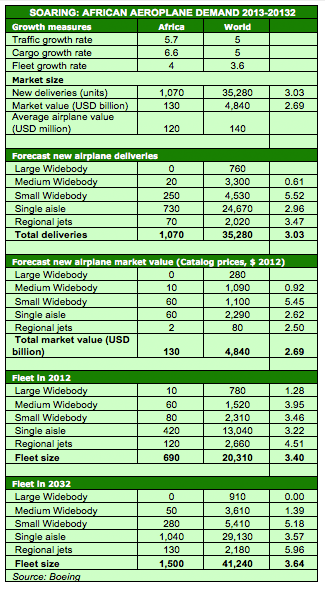
As Africa's tourism sector gears up, demand for air travel is also rising. The continent will see air traffic growth soar 5.7% annually over the next two decades, beating the global average of 5%, according to estimates by commercial air-plane maker Boeing. In addition, air cargo will also grow 6.6% annually over the next 20 years, compared to the global average of 5%, while the continent's air fleet will rise 4% each year during the period, again beating world average of 3.6%, the plane-maker forecast.
In all, the African continent will take deliveries of 1,070 new aircraft with a combined market value of USD 130 billion by 2032, as business and leisure air travel remains at elevated levels in the region. "Growth to and from other emerging markets is expected to lead the way, as airlines both in Africa and other emerging market regions are planning to increase inter-regional connectivity," Boeing said in its forecast for African air travel. Europeans will remain strong visitors to Africa, as business and leisure ties improve and African states make a more concerted effort to improve their air links to other economies.
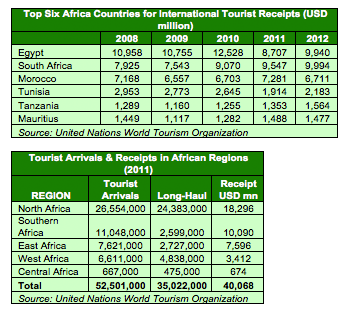
Africa has also seen a 36% increase in arrivals from the United States over the past five years, with nearly one million US visitors in each of the past three years, according to Office of Travel & Tourism Industries for the International Trade Administration at the US Department of Commerce. "In fact, for the last three years, the Africa/Middle East region has accounted for nearly 10% of the overseas travelers," said Ron Erdmann, deputy director of the US Department of Commerce in a report. "This is a peak for the region, which has seen its share increase four percentage points since 2006."
More than 500,000 Chinese tourists visited Egypt, South Africa, Ethiopia, Algeria and Kenya in 2012, as Africa also emerges as a major tourist destination for other emerging markets. "Prospects for intra-African growth are also rising. Airlines in the region are exploring new business models and development of intra-regional hubs," Boeing said in its report. "Growth in pan-African airline networks can bring the efficiency of air travel to the continent's transportation system. The flexibility of aviation networks and the relatively low cost per network kilometre make aviation infrastructure investment very attractive compared to investment in other modes."
While Africa is home to some of the diverse and breath-taking sceneries on the planet, including deserts, rivers, savannahs and wildlife, it has not tapped its true potential. The continent accounts for 20.4% of the world's land area, but receives only about 3% of world tourism receipts and 5% of tourist arrivals.
"To maximize Africa's tourism potential, critical investments are needed in key infrastructure sectors, e.g., transport, energy, water and telecommunications," according to professor Mthuli Ncube, chief economist and vice president, African Development Bank Group, adding that intra-African tourism offers some low-hanging fruits to unlock revenues.
"It is significant that on average, African citizens require visas to visit 60% of African countries. Loosening of visa restrictions would go a long way towards boosting business and leisure traveler flows, thereby contributing to the economic and social development of local economies and communities."
But the continent's prominence as a tourism destination is growing. Africa's international tourism arrivals shot up to 63.6 million in 2012, compared to 37 million a decade ago. Meanwhile, tourism receipts stood at USD 43.6 billion in 2012, with key destinations such as Morocco, Egypt, Madagascar, Seychelles and South African leading the way. Most crucially, travel and tourism employed 8.2 million people in Africa, highlighting its strength as a strong job creator.
TAILWINDS:
The International Air Transportation Association says that African airlines international air travel rose 5.5% in 2013, slower than 2012 growth of 7.5%, primarily due to slow down in South Africa and political turmoil in North Africa. "Overall, the demand backdrop for carriers in the region is strong, with robust economic growth of local economies and continued development of internationally trading industries. But some parts of the continent have shown weakness, including the South African economy, which has recently experienced a slowdown," IATA said in its latest report.
"There has also been some slowdown in regional trade growth. These developments have placed downward pressure on growth in demand for international air travel, which slowed in H2 2013 compared to earlier in the year." But there has been a concerted effort to improve the continent's tourism infrastructure, from the 40,000 new hotel rooms being built in the continent, to the improved air connections from Gulf, European and African airlines such as Ethiopian, South African airways. Air travel is also hindered by two key factors. First is safety: In 2012, African airlines had one accident (with a Western-built jet aircraft) for every 270,000 flights. Globally, the industry average was one accident for every five million flights, according to IATA data.
Secondly, heavy taxes on fuels, tickets and lack of liberalized routes is holding back the development of low-cost carriers. "Aviation connectivity links the continent's businesses to global markets. And that generates economic opportunities. But, if aviation charges and taxes are too high, its ability to be an economic catalyst is compromised," IATA said.
Source: Zwaya
Ethiopian Airlines chief warns that African carriers could be 'swallowed' by the Gulf

The CEO of Ethiopian Airlines Tewolde Gebremariam has warned that Gulf carriers could eat us for their lunch unless there is a concerted effort by African airlines to get increase market share from the fast-growing continent.
Speaking at the Aviation Club in London, Gebremariam said “We have tremendous competition coming from the Gulf carriers. Dubai is only three and half hours away from Addis, Abu Dhabi and Doha the same. They have been doing very well and now Africa is also in their centre of strategy. “We see the centre of gravity moving from Europe to the Middle East and especially the Gulf.” He said that Europe’s failure to respond to the threat by the Gulf carriers had led to this change. “Europe has been the oldest and most successful for hub and spoke operations with airports like Heathrow, Frankfurt, Amsterdam and Paris. For passengers travelling from south and north America to Europe, Africa and Middle East and Asia the only way was through Europe, but now that hub and spoke is moving to the Middle East and unfortunately and inadvertently European governments and politicians are helping them move the centre of gravity to the hubs in the Middle East by making it very difficult for airlines to operate in Europe.
“Taxation is one factor, airport congestion is another,” Gebremariam said. “As a result airlines are finding it very difficult to fly to Europe. Heathrow is one of the most congested airports. Ethiopian wants to fly to Heathrow twice a day, but we are only able to fly six flights a week. We can’t even get a daily service. A third runway at Heathrow has been discussed for years yet Dubai was able to build Dubai World Central Airport with six runways in short order.
“Frankfurt Airport has put a policeman in the ATC tower to ensure no flight leaves after 10 or 11 o’clock at night, emission trading is another problem for all of us. Labour unions are very difficult for European carriers and they also have to compete with the Gulf carriers and small African carriers like us also. The tax regime in the Gulf is different – no tax at all - but knowing this again, there is no remedy for small carriers in Africa and also Europe, so inadvertently Europe is helping the Middle East carriers. Gebremariam said that the Gulf countries are treating aviation as a strategic national asset. “The contribution of aviation to social economic development is recognized and it is the pride of governments, but other governments and even in Africa are not recognizing this unfortunately.
We are growing very fast but we have a serious challenge when considering that 80% of traffic between Africa and the rest of the world is controlled by non-African carriers – All of us - Kenya Airways, Ethiopian, South African, Egyptair, Air Morocco, TAG Angola, CAM Air, Rwandair, Arik Air and so on –put together - we only have 20% of the market. This is a big, big challenge if we don’t do something to at least maintain 50% of the market. Otherwise we are going to be swallowed and they are going to have us for their lunch.”
Source: Arabian Aerospace
Monday, 10 February 2014
Regulations stifle airline growth, says fastjet CEO

FASTJET CEO Ed Winters has called on the government to do more to create a level playing field for airlines to operate in South Africa. He said Africa should be looking at ways to deregulate the market, as happened in Europe, as the current regulatory impediments and bureaucracy were hampering the growth of the industry.
"In the ’80s and ’90s Europe used to have loads of loss-making state airlines, guzzling money from the taxpayer and distorting the marketplace. Now they have a thriving, healthy and competitive aviation industry." The company has said that regional routes from South Africa to sub-Saharan destinations lack effective competition and are underserviced and overpriced. "The level of protectionism that we see is incredible, not just in South Africa, but throughout sub-Saharan Africa. Almost every country is protectionist and so keen to continue subsiding their loss-making state airlines."
Mr Winters said South African Airways (SAA) was overstaffed compared to international benchmarks. "Not by small numbers but by a factor of four or five. It is a huge employer."Speaking at SAA’s recent results presentation Public Enterprises Minister Malusi Gigaba said that the airline would not consider retrenching staff as part of the long-term plan to return the ailing state airline back to profitability. SAA employs 11,500 staff.
Mr Winters said fastjet remained interested in setting up a South African operation. "We want to form a company in South Africa to operate out of Johannesburg." This would be done in compliance with all local regulations, especially the local ownership rules which require a domestic airline to be 75% owned by local individuals or entities before it can operate scheduled domestic flights. He said the company was watching with interest the court case between Comair and Safair over the local ownership rules and whether this would set new precedents around regulation.
In terms of the low-cost airline’s new route from Dar es Salaam to Lusaka, launched at the beginning of the month, Mr Winters said it was already performing above expectations. The route was proving to be extremely popular, especially for traders, as it cut down a 24-road trip to a two-hour flight. Its Tanzanian operations had one of their best months in December.
Source: BDLive
Subscribe to:
Posts (Atom)